
Why Corporate Training Doesn't Work
We're living inside a system stuck in a vicious cycle that delivers activity, not change. Is there even a way out?

There's Plenty That Doesn't Work
Corporate training in the Czech Republic burns through roughly billions of crowns every year (a direct-cost estimate based on CVTS 2020 data). Is that a lot? Not much? At Tempo, we think it's actually too little – an amount under CZK 3,000 per employee per year (including mandatory training) really doesn't strike us as staggering. All the more reason that every crown spent needs to pay off for the company, whether through better financial performance or more value delivered to customers. And that's where it starts to hurt:
- Training is disconnected from business strategy: the company does a superficial needs analysis, subscribes to various online libraries, buys generic "soft skills" or "AI" courses (honorable exceptions aside). No wonder L&D can't then show what it actually helped with – undermining its own legitimacy in the process. "Fun" fact: the share of L&D professionals who see learning as tied to organizational goals is actually declining.
- We measure attendance and satisfaction: only about 35% of companies have a process for measuring so-called transfer (i.e., real behavior change and business impact); the rest stop at "did you like it?"
- Training happens as isolated one-off events, with no connected system: companies (still!) order standalone courses instead of continuous learning built into the work itself (so-called learning in the flow of work).
- A learning culture is more wishful thinking than reality: everyone wants to build learning organizations, but only 36% of L&D professionals feel they're succeeding; learning still isn't a priority and isn't seen as an investment.
- Transfer into practice fails: even beautifully taught skills may never show up in someone's work if the environment doesn't call for them – once the course ends, people hit a wall, and starting to do things differently becomes nearly impossible (Blume et al., 2010).
Feeling depressed yet? Let's keep going.
Transfer Into Practice Is the Ultimate Goal – and It's Failing
"Even the best external training partner can only influence things partially (take on the assignment properly, design a tailored program, deliver a professional performance…). But they still have no influence over what happens before and after the course, i.e., inside the organization. That's HR's job instead – often junior, without the authority or necessary competencies. So they can't guarantee the complete learning cycle and transfer into practice. And then there's the manager's role, over whom even the best HR has only limited influence…"
That was my starting thought when I sat down to write this post. And I needed to dig into it further. What actually determines transfer into practice?
This was already described back in 1988 by Baldwin & Ford (and more recent research only confirms it) – transfer is essentially shaped by three groups of factors:
- Trainee characteristics (motivation to learn, personality traits, self-confidence, and general ability).
- Training design (how the training is built – needs analysis, modules, assignments, follow-up). This is the one and only factor an external partner actually controls..
- The organizational environment (support from superiors, company culture, opportunities to apply skills in practice, and feedback).
So without the right environment in place (the so-called "transfer climate"), transfer is practically impossible, even when the first two factors are in place.
Is HR to Blame?
Not really…
Even competent HR hits a wall. The decisive levers of the transfer climate (set goals, consequences, the opportunity to use a skill) are controlled by the line manager, not HR. HR usually plays an advisory role toward managers, so it can suggest a follow-up, but it lacks formal authority. It can't require that a manager change people's work assignments after a course and start rewarding their new behavior. So what HR is missing isn't skill – it's authority. It gets the task of "arranging training," not the mandate to "change behavior in practice."
The Whole System Is Built So That No One Owns the Result
So it really doesn't work. There's no clear ownership, and I think that's the core of the problem:
- The external partner owns the training event, not its outcome – and can't, because the outcome depends on things beyond their reach. They're often highly competent (sometimes not), but they have no influence over the organizational environment (one of the three transfer factors) – they're simply not in a position to change anything systemically.
- HR handles the process and the purchasing, not the actual work or performance.
- The manager is accountable for work/performance, but not for the learning process.
- From the system's point of view, the participant themselves has no ownership at all.
The cost of doing the transfer properly (the manager's time, consistency, follow-up) is borne by one party, but no one is actually measured or rewarded for the result. Or looking at it from another angle: the business orders training, the L&D team delivers it – often without diagnosing the real problem in the first place (which an L&D program might not even solve).
The system is simply built to deliver activity, not change.
Is the Manager to Blame?
The manager holds exactly the levers that determine transfer – goals, opportunities to use a new skill, and consequences (recognition/feedback when someone tries it). But…
"82% of people step into management roles without any formal management or leadership training and are promoted for the wrong reasons (they're well-liked, good at their specialty, or simply happened to be available)."
No wonder they then don't know how to do follow-up. The steps research recommends (a pre-course kick-off, creating an opportunity to use the skill, developmental feedback) are themselves skills – ones the manager never learned. It's actually ironic: the manager is themselves a perfect example of zero transfer (they got promoted and never received any "tailored training" or follow-up).
But okay, let's say they do have the necessary skills. They still run into further barriers:
- Has conflicting incentives
The cost of supporting transfer is concrete, immediate, and personal (time and attention). The benefit is diffuse, delayed, and hard to attribute (better team performance a few months later, which no one traces back to the manager's post-course follow-up). Transfer also requires the manager to temporarily accept a dip in performance. When someone tries a new skill, they're initially slower and worse at it (the learning curve). But the manager is simultaneously under pressure to deliver output/results – so the work environment actively punishes exactly the behavior that transfer requires. The organization is effectively saying two contradictory things at once: "learn new things" and "don't let your performance drop".
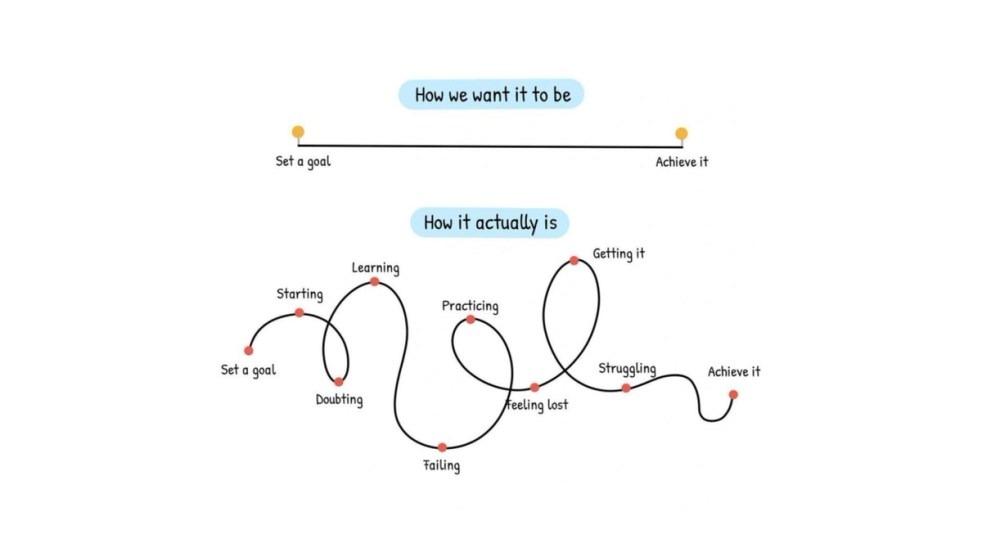
- The manager often didn't even request the training
It came from HR or "from above." In this chain, the manager is set up as the recipient of an activity, not the owner of a result. And I don't keep watch over what isn't mine. - Doesn't have the time
Organizational structures are flattening: 41% of companies, according to Korn Ferry, have cut management layers, which has increased the number of direct reports per manager. Meaningful 1:1 conversations require roughly 30–60 minutes per person per week; with a large team, these turn into status updates, and the coaching that's so badly needed disappears first. - Correctly reads what the company actually values
Team development usually isn't in the manager's goals, isn't part of their bonus, isn't a promotion criterion, and their own boss doesn't follow up on it with them either. The manager rationally concludes that the company doesn't actually treat development as a priority, and acts accordingly.
Bottom line: until people development shows up in managers' goals, evaluations, and rewards, everything else remains an optimization of the parts of the system that have no bearing on the result. And those are decisions held neither by the external partner nor by HR, but by the company's leadership.
The Vicious Cycle Closes – at the Leadership Level
The people who actually have the power to prioritize training and knowledge transfer are leadership. But for them, systematic team development usually only becomes a topic once the shoe is really pinching – for example:
- They can't execute company strategy without new capabilities in their people (AI, automation, entering a new market, a new business model, an acquisition). Do you know anyone this doesn't apply to?
- There's no way to simply hire certain skills (a shortage of people in the market, demographic decline, too narrow a specialization – hello, Czech reality). Or hiring is so expensive and slow it stops making sense.
- They fear the risk of depending on irreplaceable people (no succession plans exist, know-how isn't passed on, and their departure risks botched project execution).
- They're losing top talent, because elsewhere offers more development opportunities.
This is usually where work with real meaning and impact begins. The whole process starts with finding the right "business pains," using them to pick a handful of strategically important themes, prioritizing them, and giving them proper leadership support. Then comes good diagnostics, setting clear goals, strengthening team leaders' competencies, and gradually building a learning organization.
The knowledge economy has been here for a long time now, and it simply can't be ignored any longer. We often meet managers who know they need to start doing things differently, but feel trapped and unable to move the needle. It's a complex problem, and what they lack is capacity, distance, and a fresh perspective.
Systemic change in corporate training is, in our view, the most urgent and essential precondition for the competitiveness and prosperity of Czech companies.
Transforming an entire organization is a project with its own methodology, and a clear beginning and end. If you're considering such a project, or are in the middle of one right now, don't hesitate to reach out to us at Tempo at studio@tempo.ooo or message me directly on LinkedIn.
